Suphini’s Step-by-Step Process for Custom Handmade Dance Shoes
Ordering custom handmade dance shoes can feel like stepping into unknown territory, especially if you have spent your whole dance life grabbing whatever is on the shelf at a retail shop. Will they fit? How long will it take? What if something goes wrong? Suphini has refined a clear, step-by-step process that removes all the guesswork and replaces it with confidence. From the moment you reach out to the moment you lace up your finished shoes, every stage is designed with your needs in mind. Let me walk you through exactly how it works so you know what to expect when you decide to treat your feet to something truly made for you.
Starting With Your Dance Story and Foot History
The process does not begin with measurements. It begins with a conversation. Suphini asks every custom client to share their dance story: how long have you been dancing, what styles do you practice most, and what have you hated about previous shoes? We also want to know about any foot issues you have dealt with, such as bunions, plantar fasciitis, hammer toes, or recurring blisters in specific spots. This history tells us what to avoid and what to prioritize. A dancer with morton’s toe needs a different toe box shape than someone with a wide forefoot. A professional who dances six hours daily needs more durable materials than a recreational student. This opening conversation happens by phone, video call, or detailed email, whichever suits your schedule. We listen carefully because your story shapes everything that follows.
Capturing Precise Measurements and Foot Shapes
Once we understand your needs, we move to the technical work of capturing your foot’s exact dimensions. Suphini provides a custom measurement kit that includes large sheets of paper, a soft fabric tape measure, and illustrated instructions. You will trace both feet while standing with equal weight distributed, then again while pointing your foot as you would in a dance shoe. These two positions reveal how your foot changes shape under the demands of dancing. We also ask for four specific circumference measurements around the ball, instep, heel, and ankle. For the most accurate results, many clients also send photographs of their feet from the side, top, and back while standing on a flat surface. Some even ship us a simple plaster or foam impression kit. All this data goes into a file that our last makers use to select or modify the wooden form around which your shoe will be built.
Selecting Materials From Our Library of Options
With measurements complete, the fun part begins: choosing your materials. Suphini maintains a library of leathers, suedes, satins, and performance fabrics in dozens of colors and finishes. You can select full-grain calf leather for durability, soft kidskin for flexibility, or shimmering satin for competition elegance. For the lining, we offer breathable cowhide or plush microfiber. Sole choices include classic oiled suede for smooth floors, textured rubber patches for outdoor surfaces, or hard leather for character shoes. You also decide on hardware: buckles, laces, elastic straps, or zippers. Heel height and shape are fully customizable, from a low character heel to a dramatic ballroom flare. Suphini sends swatches of your top choices so you can see and feel the materials before committing. This selection process ensures your shoes not only perform well but also look and feel exactly the way you want them to.
Building and Modifying the Wooden Last
Here is where the magic truly happens. Suphini’s last makers take your measurement data and material choices and either select an existing last from our library or modify one to match your unique foot shape. Modifications might include adding volume to the instep area, narrowing the heel pocket, or creating extra room along the outer toe line. This work is done by hand using thin layers of leather or cork that are glued, shaped, and sanded until the last mirrors your foot. The last is then coated and sealed so it will not absorb moisture during the shoe-making process. You do not get to see this stage directly, but we send progress photos and updates so you know your shoes are moving forward. A well-made last is the difference between a shoe that merely fits and a shoe that feels like it belongs to you.
Cutting, Skiving, and Stitching the Upper
With the last ready, our artisans begin crafting the upper, which is the part of the shoe that covers your foot. Patterns are laid out on your chosen leather, and each piece is hand-cut using a sharp knife to follow the natural grain. Cut pieces then go to the skiving station, where edges are thinned down so seams lie flat and do not create internal ridges. Stitching follows, with each seam sewn on a machine calibrated specifically for dance shoe construction. High-stress areas receive double stitching or reinforcement patches. For shoes with decorative elements like crystals or embroidery, those details are added now by hand. The result is a flexible, three-dimensional upper that already hints at the final shape. You can request a photo of your cut and stitched upper before lasting if you want to see the craftsmanship in progress.

Lasting and Attaching the Sole
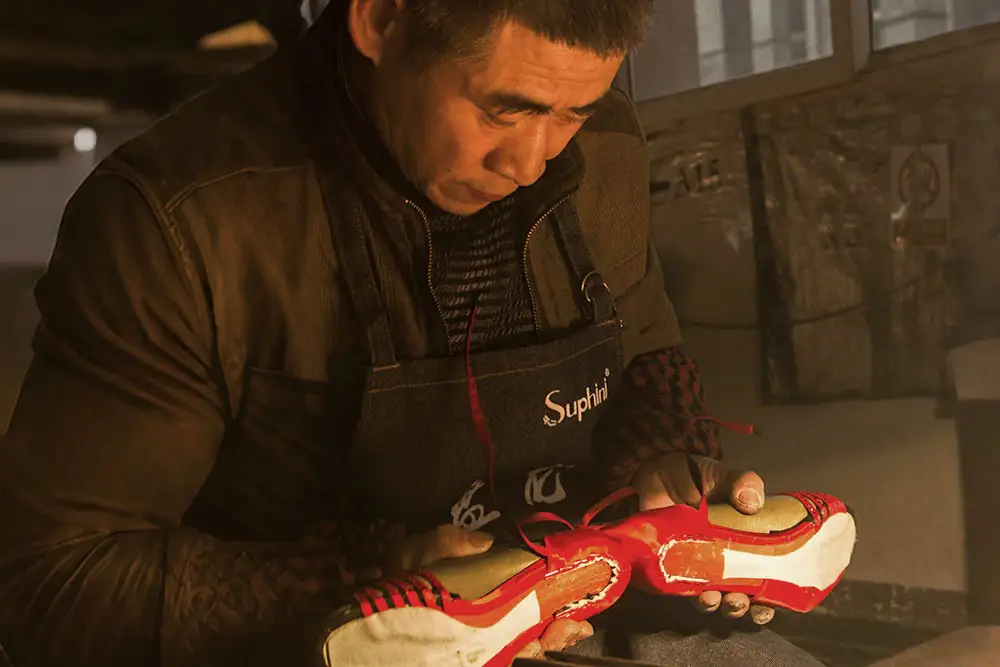
The upper now moves to the lasting table, where it is stretched over your custom wooden last and tacked into place. This process requires significant strength and precision, as the leather must be pulled evenly to avoid wrinkles while maintaining the correct tension. Once the upper is perfectly seated on the last, the sole is attached. Suphini uses a combination of high-grade flexible cement and, for certain styles, a Goodyear welt that adds stitched security. The sole is trimmed flush with the upper, then sanded and burnished for a clean edge. Heel blocks are built up layer by layer from stacked leather, then shaped and covered with a suede top piece. The shoe remains on the last for at least twenty-four hours to allow the adhesives to cure fully. This waiting period is essential for longevity, so we never rush it.
Final Finishing, Inspection, and Your First Fitting
The last is carefully removed, revealing a completed shoe that has never been worn. Suphini artisans then perform a final finishing pass, trimming any loose threads, buffing the leather, and adding any last-minute details like heel pads or arch inserts. Each shoe then undergoes a rigorous inspection: flex testing, seam pulling, and a thorough visual check under bright light. For custom orders, we often arrange a final fitting where you try on the shoes and provide feedback. If any adjustments are needed, we make them before the shoes leave our workshop. Once you confirm the fit and finish, your custom Suphini shoes are carefully packed with care instructions and shipped to your door. From your first conversation to your first dance in shoes made just for you, the entire process typically takes four to six weeks. The result is a pair of shoes that fits so naturally, you will wonder how you ever danced in anything else.


Comments
Post a Comment